Some of Godfrey's collections touch on history far outside the Library's New England focus. The insignia of the Daughters of the American Revolution is a point of pride for the Society. One Godfrey collection suggests that the insignia might have had Connecticut ties.
The Godfrey Library is the repository of the Collection of books and papers of Daughters of the American Revolution, Wadsworth Chapter. Page 29 of the Historian's Report, Volume II recounts the founding of the Chapter - and its ties to the insignia's creator. According to the website of a South Carolina DAR chapter, George Goode
designed the insignia, modeling it on his mother's spinning wheel.
"Our indebtedness to Dr. G. Brown Goode of Washington, and to his wife, our first member, can never be over-estimated. Dr. Goode, a graduate of Wesleyan and a citizen of Middletown (we are proud to recall) while visiting friends in Middletown, in 1891, spoke of his great interest in a new society that was organized a year before in Washington, and known as the Daughters of the American Revolution. He so impressed some of our patriotic women that he was requested to forward from Washington the requisite application blanks, twelve in number. These blanks were received and soon executed, and his ladies are now designed as charter members of Wadsworth Chapter."
Wadsworth Chapter, Connecticut's first, therefore, can claim a role in the creation of DAR's best known symbol - or perhaps the reverse is true!
Interested in the history of Connecticut's DAR chapters? Check out our library catalog for a DAR publications, papers, and more!
Friday, January 29, 2016

Friday, January 22, 2016
We're More that Just a Website: the Library's Unique Revolutionary War Collection
If you're in the midst of preparing a DAR or SAR application, you know how valuable sources with information about your ancestor can be - and how hard they often are to find. Godfrey can help!
Our collection goes beyond what's available online. For example, this book might be a valuable resource.

Compiled in 1976 by the Stamford Genealogical Society, this copy of Stamford's Soldiers: Genealogical Biographies of Revolutionary Patriots from Stamford, Connecticut is one of only 500 printed. And for a DAR applicant, it is a gem. The book contains short biographies of all 738 men with known connections to Stamford during the Revolution. While it is uncited, it offers the dates and places where a soldier died, was buried or had his will probated. For a lineage society applicant, this book might make your research much easier.
Thinking it's time to visit the library in person? Visit us at www.godfrey.org for directions.
Friday, January 15, 2016
Godfrey's Family History Center Helps Bring History to Your Fingertips
Have you wondered how to access your ancestors' records when they lived far away? Today's guest post gives you a glimpse of what can be found using films delivered to Godfrey's Family History Center. For more information about the center's hours, please visit our website.


Use of Real Estate Deeds to Uncover
Spousal Identity
Identifying the names of spouses
during the 1700s and 1800s is always a challenge. Real estate deeds can be a useful tool in
this effort. Other than a few
commercially prepared abstracts, information from real estate deeds can be
obtained either by going to whatever jurisdiction in which the deed was
recorded or (more easily) by obtaining microfilm through a Family History
Center such as found at the Godfrey Memorial Library.
For many years I worked on the
family of one of my 4th great-grandfathers, George Smith. I found his 1772 marriage record to his wife
Barbara, baptismal records for their children and other records which traced their
life together in Upper Mount Bethel, Pennsylvania for about twenty years. Then, in 1796, a deed was recorded where
George Smith sold his land in Pennsylvania, prior to his move to Sussex County,
New Jersey. Pennsylvania law required
the spouse to also sign the deed and to do so “to be their free act.” In this case, his wife’s name is listed as
Susannah. Since no death or burial
record was ever found for the first wife of George Smith, and no marriage
record was ever found for this second wife, this deed becomes the only evidence
that his first wife was deceased and that he had remarried.
As I tracked George Smith’s real
estate transactions in New Jersey, his wife continued to be Susannah. An 1808 marriage record for George Smith to
Sarah Compton was found among the Sussex County records but without confirming
evidence, the record could not be relied upon.
This confirming evidence was found in an 1809 real estate deed where
George Smith and his spouse, Sarah, are seen selling 10.92 acres of land. The deed states that Sarah was the widow of
Jacob Compton and that she had acquired the land from a William Compton. Thus, this record confirms the 1808 marriage
record and further agrees with the 1812 will of George Smith where he
identifies his spouse as Sarah Smith.
Obviously, his second wife, Susannah is deceased prior to the date of
the 1808 marriage. Still to be
determined is Sarah Compton Smith’s maiden name. Nevertheless, the use of real estate records
can identify a spouse’s given name; give approximate time periods of a marriage
and also the date by which a prior spouse is deceased. Also, as seen in this case, the prior
marriage of a spouse is identified and if the land was inherited from her
father, his name would have been identified.
Much of early real estate law, and
all other laws, was modeled on English common law which in general did not
provide rights to females.
Nevertheless, the concept of a spouse’s right of dower to her husband’s
estate was generally found in common law.
Similarly, English common law, while generally denying a wife of a
separate identity, did provide a protection to a woman by preventing a husband
from selling real property without the wife’s consent which was also adopted by
many of the colonies. Thus, the spouse
is identified when they are selling real estate and her signature (or mark),
provided freely (and often after a separate interview) was required on the deed
in many states.
Friday, January 8, 2016
Searching Godfrey Scholar just got easier!
Searching for a Smith or Brown ancestor?
Searching in Godfrey Scholar just got easier.
Thanks to recent updates, you can add a year or range of years to your name search.

If you know the exact year, enter in the box next to "year."
Need to search a ten year period? Imagine you want to search for someone who died between 1880 and 1890. Enter 1885 in the year box. Change the zero to five. The search will now include any results dating from five years in either direction.
No more having to read through results too old or too recent to be your ancestor!
Sunday, October 11, 2015
Leave no Stone Unturned by Diane Reid
Godfrey Memorial Library is an
amazing place. In the more than fifteen
years I have been volunteering as a docent and researcher, I have met and been
able to help genealogists from all across the United States, and in a few
instances, those from other countries. Some people have lots of information
about the ancestor they are researching, some have nothing more than a name, a
general birth year, and, if we’re lucky, a town. We are able to find information most of the
time using the many resources available to us here at the Godfrey.
Then there are the people that no
one appears to be searching for. They are the persons who died and are buried
in cemeteries across the United States, most with no stone to mark their grave,
buried in what used to be called “pauper’s graves”. Most towns have lots for the burial of those
without family or funds, and some churches have lots for that purpose also.
Indian Hill Cemetery in Middletown
has both. A beautiful cemetery opened in
1850, Indian Hill Cemetery is the final
resting place for more than 9,000 souls.
There is a large city lot, and a lot owned by the local Episcopal
Church. These lots contain very few
stones to mark the final resting places for those buried here. I have been researching those buried in the
church lots to identify them and document something about their lives. I hope to see a marker erected on the lots
listing the names of those who rest among strangers.
The resources at the Godfrey have
been of tremendous help in discovering the resting places of those who would
otherwise be lost to history. The Ed
Laput Cemetery Cemetery Project has recorded names and dates from 950 Connecticut cemeteries and 37 in other states, along
with photos of the sites if available.
This collection is just part of Godfrey's online materials available to
members.
In
addition, Godfrey has copies of the records of the Episcopal Church of the Holy
Trinity, and the vital records of Middletown and the Sexton Returns from 1892
to 1900. Add to this the Middletown City Directories, the Penny Press newspaper
from 1884 to 1921, and the Indian Hill Cemetery burial records, and I have been
able to locate information on close to fifty persons buried in the church lot
since 1851.
As an example, the sixth and seventh burials in the
church lot were the 800th and 852nd at Indian Hill. They were of Elizabeth Martin and her son
William Andrew Martin, who died six months apart in 1876. The Indian Hill
Cemetery Internment Book says Elizabeth was 35 years old when she died of
pneumonia. The Middletown Vital Records
give her birthplace as Wilmington North Carolina and stated that she was married to Henry John Martin, a stone
worker. The church records list two
children, John Henry, b.2 Apr 1871, baptized the 12th of that month,
and William Andrew b. 15 Jul 1875, and baptized 15 Aug 1875. William died in Sep 20, 1876 six months following his mother’s
passing and was buried with his mother in the same grave. In
1880, John Henry was living in the Hartford Orphan Home. Neither Henry John nor his son John Henry
were located in the 1900 census.
This is just one
example of the many resources we have available to help you discover
information about your ancestors. To
learn more, come in or go to our website.
Friday, January 9, 2015
Middletown Midwife Records
Birth records of any kind are invaluable to genealogists. These are most often found in vital records for a town or county or sometimes in church records, though baptismal records are more common. At the Godfrey Library, we are lucky enough to have a very unique birth record for Middletown and Ansonia Connecticut as a part of our collection. In 2009, Marie Carta donated the record book kept by her great aunt, Sebastiana Grimaldi Misenti, a midwife. But Sebastiana was not just any midwife: because she was born and initially raised in Melilli Italy, she was the midwife of choice for all the Italian families in Middletown and Ansonia who emigrated from that area.
In the late 1800s and early 1900s the Middletown area experienced a flood of immigrants from the village of Melilli on the island of Sicily. Immigrants traveled to the Middletown area on the advice of a former resident of Melilli who wrote home about the great opportunities the Middletown area afforded. Though they were not the first Italians to settle in the Middletown area, by virtue of sheer numbers the population of immigrants from Melilli had an enormous impact on Middletown's history.
Families from Melilli formed a close knit community in the area east of Main Street Middletown. It was this community and a similar population in Ansonia that Sebastiana served as a midwife. Her record book in the Godfrey collection contains the names of 934 children she delivered from 1909 to 1935. Each entry contains the gender and name of the child delivered, the name of their mother and father, and their date of birth. The records are written entirely in Italian. The Godfrey was lucky enough to have a volunteer whose first language was Italian to help us index these records. The index and scans of the original records are available in the Godfrey Scholar Digital Collection.

If you have Italian ancestors from Middletown or Ansonia Connecticut who originally hailed from Melilli Italy it is highly likely that they or their children were delivered by Sebastiana. She sounds like an amazing woman who made an incredible impact in her community. Despite this, there is little information to be found about her. Her grave is a simple stone in the St. Sebastian's Cemetery (found using the Ed Laput Cemetery Project). These records and that stone may be the only remaining evidence of the life that helped so many.
In the late 1800s and early 1900s the Middletown area experienced a flood of immigrants from the village of Melilli on the island of Sicily. Immigrants traveled to the Middletown area on the advice of a former resident of Melilli who wrote home about the great opportunities the Middletown area afforded. Though they were not the first Italians to settle in the Middletown area, by virtue of sheer numbers the population of immigrants from Melilli had an enormous impact on Middletown's history.
Families from Melilli formed a close knit community in the area east of Main Street Middletown. It was this community and a similar population in Ansonia that Sebastiana served as a midwife. Her record book in the Godfrey collection contains the names of 934 children she delivered from 1909 to 1935. Each entry contains the gender and name of the child delivered, the name of their mother and father, and their date of birth. The records are written entirely in Italian. The Godfrey was lucky enough to have a volunteer whose first language was Italian to help us index these records. The index and scans of the original records are available in the Godfrey Scholar Digital Collection.
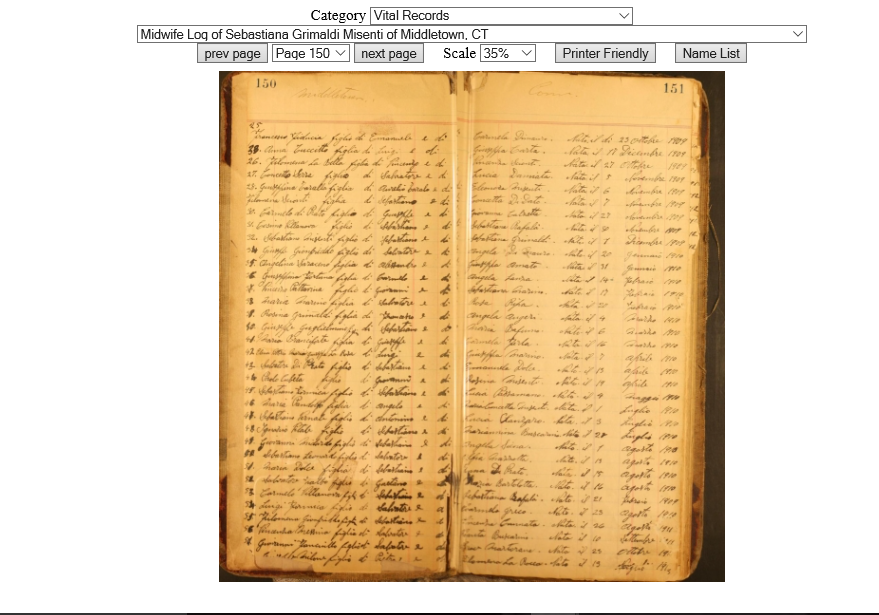
If you have Italian ancestors from Middletown or Ansonia Connecticut who originally hailed from Melilli Italy it is highly likely that they or their children were delivered by Sebastiana. She sounds like an amazing woman who made an incredible impact in her community. Despite this, there is little information to be found about her. Her grave is a simple stone in the St. Sebastian's Cemetery (found using the Ed Laput Cemetery Project). These records and that stone may be the only remaining evidence of the life that helped so many.
Tuesday, January 6, 2015
This Week on the Scholar
Below is a list of the latest books and records added to the Godfrey Scholar Online Access. Next we will add more of the Godfrey's unique content from our physical collection that cannot be found anywhere else, including funeral records, church records, and much more! Expect to see the rest of the Coughlin Lastrina Funeral Home records added to the Scholar within the next week!
Biographies
The Genius and Character of Emerson
Maria Sanford
Church Records
Cromwell First Congregational Church Book of Remembrance 1889-1962
Portland Evangelical Lutheran Zion Church Record Book, 1880-1888
Portland Evangelical Lutheran Zion Church Record Book Volume 2, 1903 and on
Funeral Home Records
Coughlin-Lastrina Funeral Home Records: Burial Returns March 1912 to November 1914 Index
Roberts Funeral Home Record Cards, 1941-1942
Genealogies
Cuccel Family Records
Descendants of Richard Smyrk
Willard, Twigs and Branches
Military: Civil War
Sketches of War History 1861-1865: Volume 3
Not a Scholar? Visit our website to subscribe or call the library at (860) 346-4375 to join today
Subscribe to:
Posts (Atom)